The
Energy Net
The
Energy Net | The
Energy Net |
|
Nuclear
Facts
|
International Uranium Mining IssuesIntroduction
Global Uranium OverviewWorldwide uranium mining produced about 41,600 tonnes of uranium in 2005. Though uranium is a fairly common mineral and is widely distributed around the earth, over half of the total uranium mining production came from just two countries: Canada and Australia. Though the U.S. was the largest uranium producing country in the world in the 1970’s, by 2005 only 3% of world production was mined in the United States. Canada |
| Sharbot Lake Protest |
Canada was the first country to mine uranium. The world's first uranium mine was at Port Radium, NWT, on the shore of Great Bear Lake. Canada was also the first country to refine uranium on an industrial scale. Uranium for the World War II Atomic Bomb Project was processed in secrecy at Port Hope, Ontario.Much of the uranium for the Cold War nuclear arms race came from Canada: Port Radium and Rayrock, NWT; Uranium City, Saskatchewan; Bancroft and Elliot Lake, Ontario. By 1960 the American military contracts had been terminated. All uranium mined in Canada since 1965 has been sold for reactor fuel. Additional Note: In 2005 Cameco's Cigar Lake uranium mine was flooded, driving up prices of uranium worldwide.
This immensely important event took place April 2008 and contains over 500 submitted testimonies on twelve major uranium mining issues. All submissions are available to read!
 |
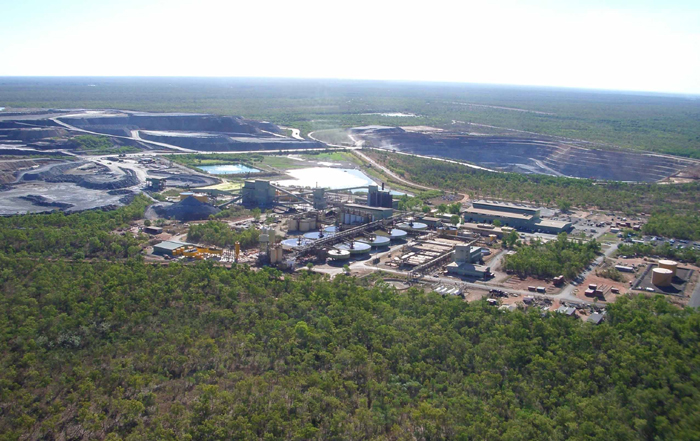
| Cameco Uranium Mine |
 John
Graham Defense Committee - Photos: Uranium Mine
John
Graham Defense Committee - Photos: Uranium Mine
 The
History of uranium mining in Australia
The
History of uranium mining in AustraliaAustralia is set to become the largest uranium producer in the world. Most of the uranium is on indigenous lands. A huge battle over a deadly industry that produces few jobs but immense wealth for BPH Billiton is at stake.
Australia has some of the uranium reserves in the world. The Beverly mine is using a technique called In-Situ Leaching (ISL) to extract the uranium. This is an extensive Australian News (video) investigation of ISL mining.
 Australian
Protest
Australian
Protest
 From
Bush's lies or EDF's scandals about Niger uranium, n-waste dumping
on poor communities, or the Rossing uranium mine in Namibia, Africa
is a hotbed for uranium mining for huge global corporations like
Rio Tinto.
From
Bush's lies or EDF's scandals about Niger uranium, n-waste dumping
on poor communities, or the Rossing uranium mine in Namibia, Africa
is a hotbed for uranium mining for huge global corporations like
Rio Tinto.
The tailing pipes carrying the radioactive and toxic slurry from the mills of the Uranium Corporation of India (UCIL) burst Saturday night(16/8/2008) in the Dungridih village under the Jadugoda police station of Potka block of East Singhbhum in Jharkhand State of India, spewing the village with uranium waste.
JADUGUDA, India — Deep in the heart of a grassy valley, thousands of laborers are helping build India's nuclear dreams at the country's only uranium mining complex. Two miles away, deformed children play in small, clay huts.
Europe has the strongest anti-nuclear movement in the world. The push to restart the nuclear power issue in Europe has been ferocious. Much has left to be done on discovering more about the scandalous Soviet era uranium mining industry, where no attempts at protecting miners or the environment was the rule.
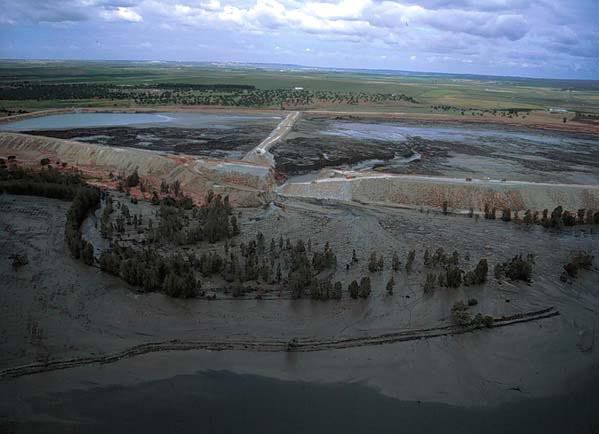 |
| Los Frailes tailings failure (Spain) |
 Iraqi
radioactivity: Greenpeace
Iraqi
radioactivity: GreenpeaceGreenpeace activists took clean water containers into the communities around the Tuwaitha nuclear facility near Baghdad and encouraged people to swap them for radioactive containers, contaminated with uranium 'yellowcake'.
 Fuel
Cycle: International Mining
Fuel
Cycle: International Mining  Global
Military Spending, Weapons Exports, Depleted Uranium, Nuclear Weapons
- Earth Web Site
Global
Military Spending, Weapons Exports, Depleted Uranium, Nuclear Weapons
- Earth Web Site
BHP Billiton is the world's largest mining company, and is ranked at 183 of all companies. It was created in 2001 by the merger of Australia's Broken Hill Proprietary Company (BHP) and the UK's Billiton, which had a South African background. The result is a dual-listed company. In 2007 Billiton made a hostile takeover bid for Rio Tinto which has not suceeded. Its U.S. holdings include the Utah Group.
Rio Tinto is the 2nd largest private mining corporation in the world. The company focuses on large, long-term, low cost mining operations in aluminium, copper, coal, uranium, gold, industrial minerals (such as borates, titanium dioxide feedstock, talc, diamonds) and iron ore. Rio Tinto is most active in North America, Australia, South Africa and Indonesia with additional major assets in South America, Asia, and Europe. There are more than 60 operations in around 40 countries.Rio Algom's Track Record
Cameco is the world's largest single uranium producer, responsible for about 21% of world production. Based in Saskatchewan, Canada, the company virtually runs the uranium mining industry in Canada, and has extensive gold and uranium exploration and mining interests internationally. In Australia, the company is actively exploring in Arnhem Land (NT) and to the north of Kintyre at Rudall River (WA). The company has close alliances with the Japanese Government (PNC) and French nuclear agency (Cogema) in these areas.
Cogema is the French Government-owned nuclear group, one of the largest suppliers of uranium in the world and the only company to offer every stage of the nuclear fuel cycle to the industry, from mining to waste management.
Cogema was created in 1976, from the Production Division of the French Atomic Energy Agency (CEA). The CEA holds a 74.7% stake in the company, which provides services to the civil and military sides of the French nuclear industry, as well as to many international clients. There is no essential division between the military, government and commercial aspects of nuclear power in France, and Cogema lies at the heart of French nuclear operations.
Urenco is jointly owned by the governments of Germany, The Netherlands and the UK and has facilities in all three countries. In the last year Urenco has expanded capacity by 7%, boasting that the expansion project at the Springfields, UK plant was its fastest yet. The company is constructing a new uranium enrichment plant called the National Enrichment Facility (NEF) in New Mexico, USA...